
 +61 414 638 895
 Change Manager Skills That Lead to Successful Organisational Change
When organisations prepare for change, whether it's a merger, a technology rollout, a restructure, or a shift in strategy, choosing the right change manager is one of the most important decisions they can make. A common question quickly comes up:
"Do we have the right person leading the people side of this change?"
It's an important question, but not always an easy one to answer.
Unlike professions with a clearly defined pathway, change management attracts people from many different backgrounds. Some come from project management, others from communications, human resources, operational leadership, psychology, learning and development, or consulting.

That's because successful change management isn't about having a particular job title or following a single methodology. It's about helping people move through uncertainty and adopt new ways of working.
Over the years, I've worked with organisations navigating everything from business transformations and mergers to process improvements and cultural change. The most effective change managers I've encountered share a number of common characteristics, regardless of their background.
They See Beyond the Project Plan
Many organisations initially view change as a technical challenge.
A new system needs to be implemented. A new process needs to be adopted. A new structure needs to be introduced.
But experienced change managers know that the technical solution is often the easier part.
The real challenge lies in helping people understand why the change matters, what it means for them, and how they can successfully transition to the future state.
For example, introducing a new HR platform isn't simply a technology project. It changes how managers approve training or leave, how employees access information, and how teams interact with existing processes. Effective change managers help organisations prepare for those human impacts long before and after the system goes live.
Never Stop Learning
The world of work continues to evolve at an extraordinary pace.
New technologies emerge. Workforce expectations shift. Organisations become more interconnected and complex.
The best change practitioners understand that learning doesn't stop once you've completed a certification or attended a workshop. They actively seek new ideas, challenge their assumptions, and continuously refine their approach based on experience.
Curiosity is one of the most powerful tools in a change manager's toolkit to uncover risks, opportunities, and perspectives that might otherwise be overlooked. Rather than assuming they know the answers, effective practitioners ask questions.
Recognising this is one of the reasons organisations are increasingly investing in building internal change capability rather than relying solely on external consultants. When leaders, project managers, and business professionals develop change leadership skills, organisations become more resilient and better equipped to navigate future challenges.
That's also the thinking behind our Change Leadership Academy. Rather than treating change management as a specialist discipline reserved for a small group of experts, we believe organisations benefit when change capability is developed at all levels across the business.
Adapt The Approach
Successful change requires both discipline and empathy. Great change managers know how to balance both sides. They understand governance, planning, and measurement while also recognising that every change experience is deeply personal for those affected.
One of the biggest misconceptions about change management is that there is a single framework that works in every situation.
In reality, every organisation, team, and change initiative is different.
Experienced practitioners draw from a range of approaches and tailor them to fit the environment they're working in. Sometimes a structured framework is exactly what's needed. Other times, a more adaptive or method-agnostic approach delivers better results.
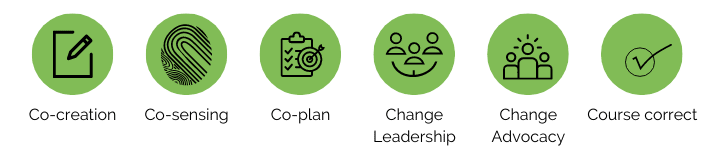
At Approach Services, we often talk about the importance of balancing structure with flexibility. Our 6Cs Change Management Framework provides a practical foundation for guiding change while recognising the strength of drawing from best-practices across our industry.
The goal isn't to follow Prosci's or Kotter's methodology perfectly. The goal is to help people successfully adopt the change and use the new way of working.
Understand the Power of Communication
When employees feel uncertain, clear two-way communication becomes one of the most important tools available to leaders.
Yet many organisations mistake communication for information broadcasting.
Sending email announcements to tell people what is happening does not necessarily help them to understand why they should care and go along for the ride.
Effective change managers focus on creating buy-in. They recognise that people need opportunities to ask questions, raise concerns, and make sense of change in their own context.
A well-designed communication strategy doesn't just inform people. It builds confidence, trust, and commitment.
Build Clear and Practical Roadmaps
One of the most valuable contributions a change manager can make is creating clarity.
When organisations are facing significant change, people often feel overwhelmed by uncertainty. Leaders may know where they want to go, but employees are often trying to understand what happens next.
Effective change managers bridge that gap.
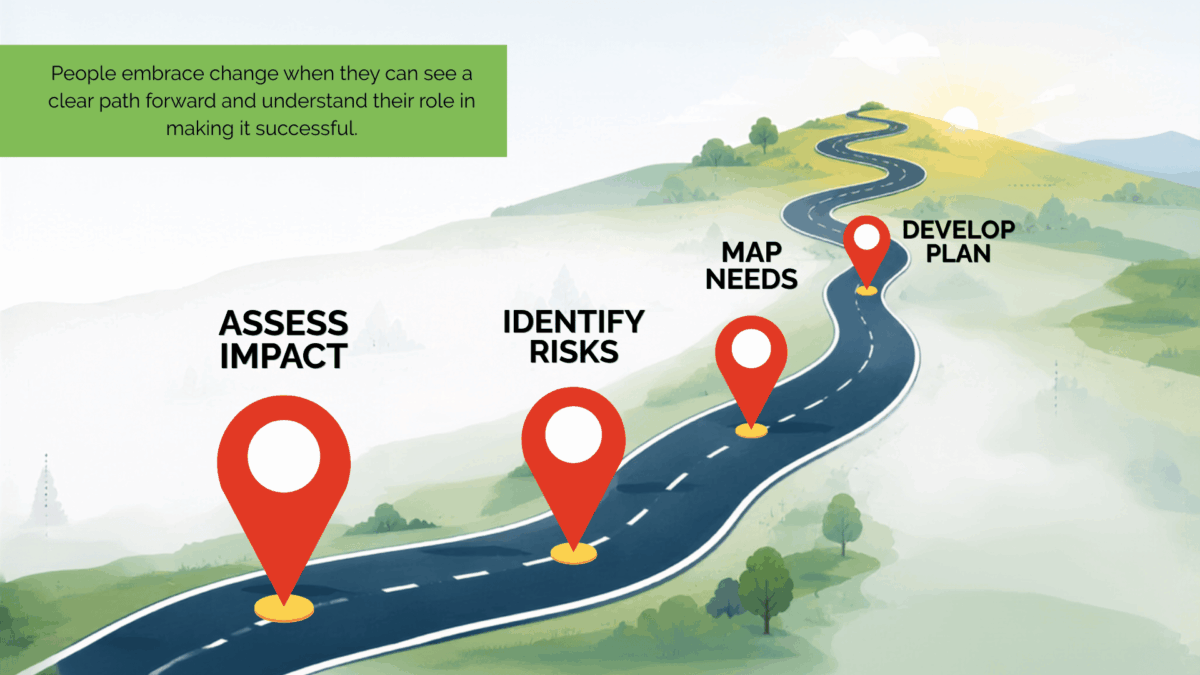
They assess impacts, identify risks, map stakeholder needs, and develop practical plans that support adoption. Importantly, they don't create plans for the sake of documentation. They create plans that people can actually use.
A good example is our work with Scitech, where leadership development formed a critical part of preparing the organisation for future growth and change. Rather than delivering a one-size-fits-all program, we worked closely with leaders to understand their challenges, align development initiatives with strategical goals, and create a structured pathway for building change leadership capability. By providing a clear roadmap that connected individual development with broader organisational outcomes, leaders were better equipped to drive change, support their teams, and contribute to Scitech's long-term strategic goals.
This highlights an important principle of change management: people are far more likely to embrace change when they can see a clear path forward and understand their role in making it successful.
Build Trust Quickly
Trust is one of the most underrated factors in successful change management.
People are far more likely to engage with your change initiative when they feel respected, listened to, and supported.
The strongest change manager invest time in understanding different stakeholder perspectives. They listen before they advise. They acknowledge concerns rather than dismissing them.
This ability to build credibility and trust often determines whether people lean into change or resist it.
Focus on Outcomes, Not Activity
One of the easiest traps in change management is confusing activity with progress.
Communication plans can be completed. Workshops can be delivered. Training sessions can be scheduled. But none of those activities matter if people don't adopt the change.
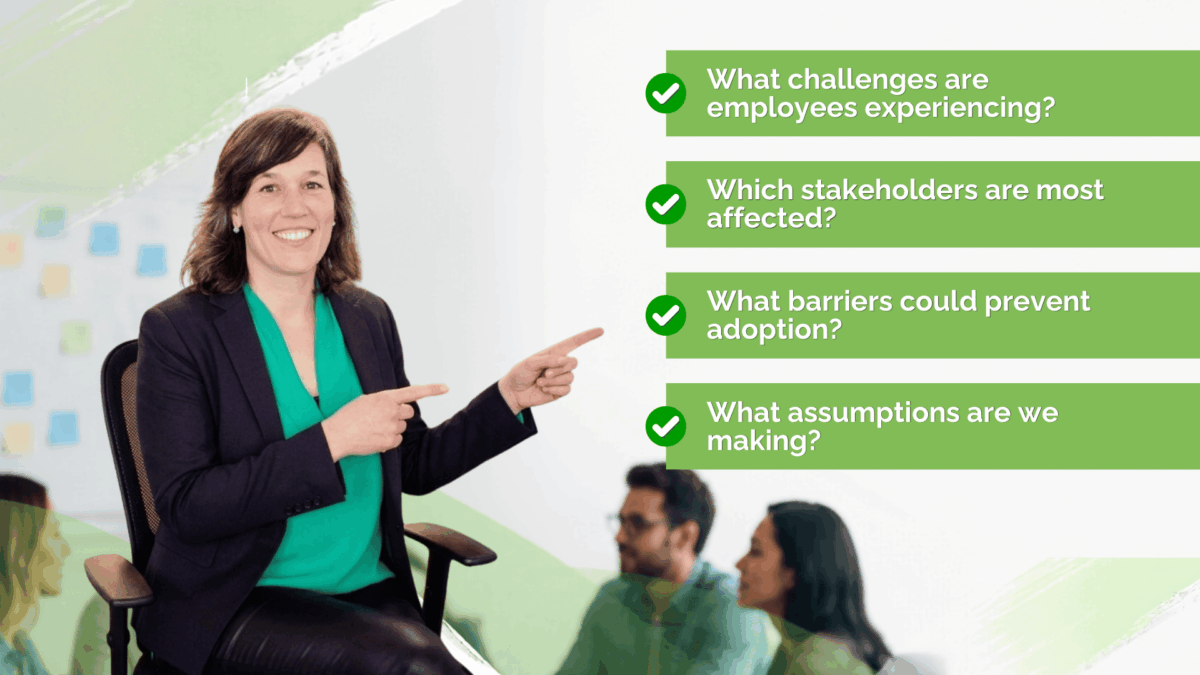
A great change manager focuses on outcomes.
These are the questions that ultimately determine success.
A recent merger integration project we supported for Altrad demonstrated this perfectly. In this project, we helped people navigate uncertainty, build alignment, and create commitment to a shared future. The result was stronger engagement, greater confidence, and a smoother transition during a period of significant organisational change.
Capability Matters More Than Credentials
Every change initiative presents unique challenges. While no two projects are identical, experienced practitioners develop a sense for what tends to work and what doesn't.
They've seen communication plans fail because leaders weren't aligned. They've watched technically successful projects struggle because adoption was overlooked. They've learned how to adjust when unexpected obstacles emerge.
At Approach Services, this collective experience is one of our greatest strengths. Our team brings decades of hands-on change management expertise across industries, helping organisations navigate complex transformations while maintaining focus on the people involved.

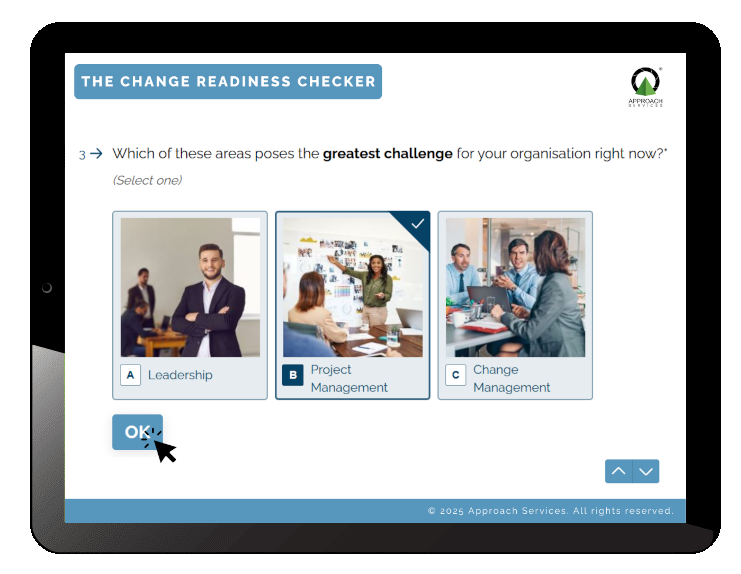
Planning a Change Initiative? Get an Expert View First.
Book a free 30-minute Change Readiness Consultation
Walk away with 2-3 recommendations, an idea of the change readiness risks, and options for training or support (if needed).
When organisations are selecting someone to lead change, it's easy to focus on qualifications, certifications, or previous job titles. While these can be valuable indicators, they don't tell the whole story.
What matters most is whether the individual can build trust, engage stakeholders, navigate complexity, and help people move confidently through uncertainty.
The most effective change manager comes from diverse backgrounds, but they share a common ability to connect strategy with people. They understand how to translate organisational goals into meaningful actions that employees can embrace and sustain.
Ultimately, successful change is measured not by how well a framework is applied, but by whether people adopt new ways of working and the organisation achieves its intended outcomes.
The best change manager makes that transition possible by bringing together structure, empathy, experience, and a genuine commitment to helping people succeed.

Eva is one of the masterminds behind Approach Services' blog and The 6 Cents of Change. She is an innovator, trainer and change manager. Her work has been published in the Schmalenbach Journal of Business Research. In her spare time, she enjoys camping with her two little boys and permaculture gardening.
Subscribe to our monthly newsletter The 6 Cents of Change and follow us on LinkedIn to learn more!